
Universal Pipette Tips
Disposable pipette tips designed to fit single and multichannel pipettes from most manufacturers; offer acceptable performance compared to pipette specific tips and can be used with a variety of pipette models.
Single-use universal pipette tips are designed for compatibility with most mechanical and electronic single and multichannel pipettors.
Universal pipette tips are available in a range of types, sizes, colors, styles, and packaging configurations and may be designed for specific purposes or tasks.
- Capacity or volume based on the pipettor size
- Filters to reduce contamination and cross-contamination
- Color
- Sterility or autoclavability
- Tip style: beveled, tapered, wide bore, round, flat, or gel-loading
- Length: short or extended
- Purity: metal-free or DNase-, RNase-, ATP-, Bioburden-, PCR inhibitor-, endotoxin-, or pyrogen-free for genomic and biologic applications
- Surface treatments to reduce retention
- Packaging options to help facilitate re-stocking or eliminate waste

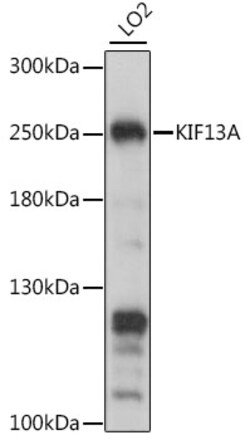
ABclonal Technology KIF13A Rabbit pAb

This gene encodes a member of the kinesin family of microtubule-based motor proteins that function in the positioning of endosomes. This family member can direct mannose-6-phosphate receptor-containing vesicles from the trans-Golgi network to the plasma membrane, and it is necessary for the steady-state distribution of late endosomes/lysosomes. It is also required for the translocation of FYVE-CENT and TTC19 from the centrosome to the midbody during cytokinesis, and it plays a role in melanosome maturation. Alternative splicing of this gene results in multiple transcript variants.

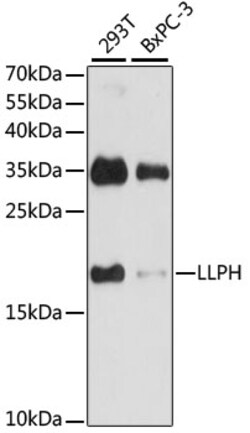
ABclonal Technology LLPH Rabbit pAb
Enables RNA binding activity. Predicted to be involved in dendrite extension and positive regulation of dendritic spine development. Located in chromosome and nucleolus.

ABclonal Technology LONP2 Rabbit pAb
In human, peroxisomes function primarily to catalyze fatty acid beta-oxidation and, as a by-product, produce hydrogen peroxide and superoxide. The protein encoded by this gene is an ATP-dependent protease that likely plays a role in maintaining overall peroxisome homeostasis as well as proteolytically degrading peroxisomal proteins damaged by oxidation. The protein has an N-terminal Lon N substrate recognition domain, an ATPase domain, a proteolytic domain, and, in some isoforms, a C-terminal peroxisome targeting sequence. Alternative splicing results in multiple transcript variants encoding distinct isoforms.
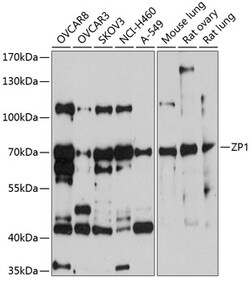
ABclonal Technology ZP1 Rabbit pAb
The zona pellucida is an extracellular matrix that surrounds the oocyte and early embryo. It is composed primarily of three or four glycoproteins with various functions during fertilization and preimplantation development. The protein encoded by this gene ensures the structural integrity of the zona pellucida. Mutations in this gene are a cause of oocyte maturation defect and infertility.
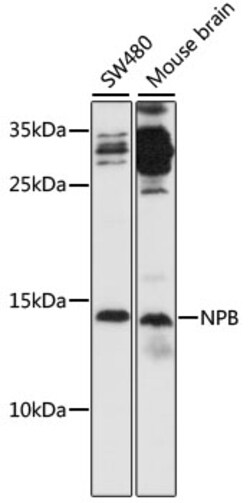
ABclonal Technology NPB Rabbit pAb
This gene encodes a member of the neuropeptide B/W family of proteins and preproprotein that is proteolytically processed to generate multiple protein products. The encoded products include neuropeptide B-23 and a C-terminally extended form, neuropeptide B-29, which are characterized by an N-terminal brominated tryptophan amino acid. Both of the encoded peptides bind with higher affinity to neuropeptide B/W (NPB/W) receptor 1 compared to the related NPB/W receptor 2. These peptides may regulate feeding, pain perception, and stress in rodents.
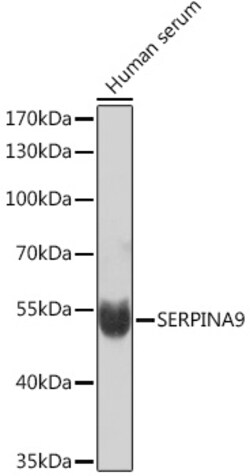
ABclonal Technology SERPINA9 Rabbit pAb
Enables serine-type endopeptidase inhibitor activity. Predicted to be involved in negative regulation of endopeptidase activity. Predicted to be located in cytoplasm and membrane. Predicted to be active in extracellular space.
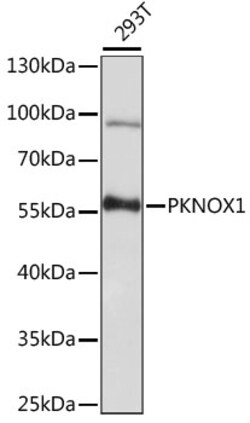
ABclonal Technology PKNOX1 Rabbit pAb
Enables sequence-specific double-stranded DNA binding activity. Predicted to be involved in angiogenesis and regulation of transcription by RNA polymerase II. Predicted to act upstream of or within camera-type eye development, hemopoiesis, and positive regulation of transcription by RNA polymerase II. Predicted to be located in cytoplasm and nucleus. Predicted to be part of chromatin.
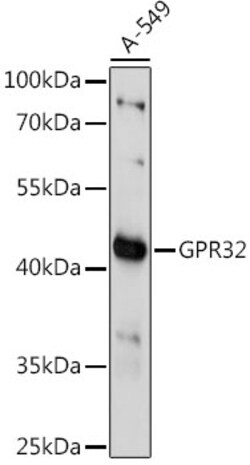
ABclonal Technology GPR32 Rabbit pAb
This gene is intronless and encodes a member of the G-protein coupled receptor 1 family. The encoded protein binds to resolvin D1 and lipoxin A4 and has been linked to pulmonary inflammation. A related pseudogene has been identified on chromosome 19.
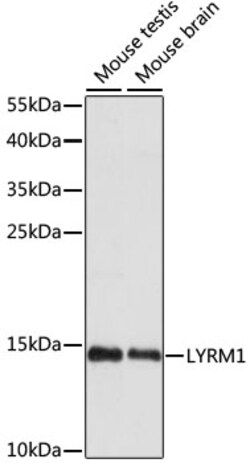
ABclonal Technology LYRM1 Rabbit pAb
The protein encoded by this gene belongs to the mitochondrial leucine/tyrosine/arginine motif family of proteins. Proteins of this family are short polypeptides that contain a leucine/tyrosine/arginine motif near the N-terminus. This gene is widely expressed with high levels in omental adipose tissue of obese individuals. In adipose tissue, the protein is localized to the nucleus where it promotes preadipocyte proliferation and lowers the rate of apoptosis to regulate adipose tissue homeostasis. Overexpression of this gene in adipocytes causes abnormal mitochondrial morphology and mitochondrial dysfunction. Alternative splicing results in multiple transcript variants.
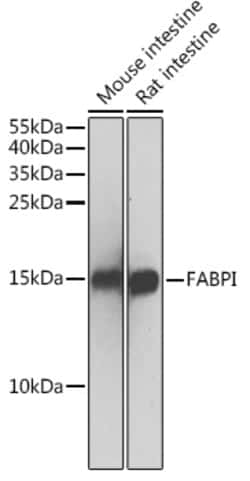
ABclonal Technology FABPI Rabbit pAb
The protein encoded by this gene is an intracellular fatty acid-binding protein that participates in the uptake, intracellular metabolism, and transport of long-chain fatty acids. The encoded protein is also involved in the modulation of cell growth and proliferation. This protein binds saturated long-chain fatty acids with high affinity, and may act as a lipid sensor to maintain energy homeostasis.
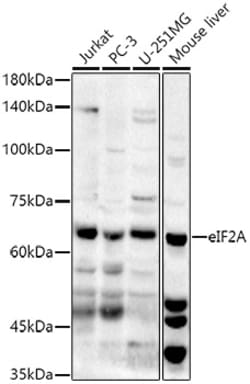
ABclonal Technology eIF2A Rabbit pAb
This gene encodes a eukaryotic translation initiation factor that catalyzes the formation of puromycin-sensitive 80 S preinitiation complexes and the poly(U)-directed synthesis of polyphenylalanine at low concentrations of Mg2+. This gene should not be confused with eIF2-alpha (EIF2S1, Gene ID 1965), the alpha subunit of the eIF2 translation initiation complex. Although both of these proteins function in binding initiator tRNA to the 40 S ribosomal subunit, the encoded protein does so in a codon-dependent manner, whereas eIF2 complex requires GTP. Alternative splicing of this gene results in multiple transcript variants encoding different isoforms.
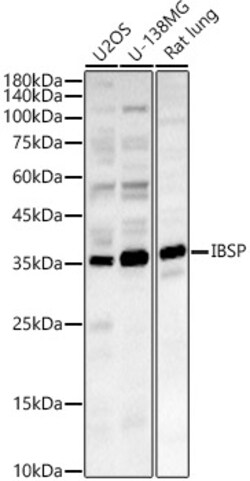
ABclonal Technology IBSP Rabbit pAb
The protein encoded by this gene is a major structural protein of the bone matrix. It constitutes approximately 12% of the noncollagenous proteins in human bone and is synthesized by skeletal-associated cell types, including hypertrophic chondrocytes, osteoblasts, osteocytes, and osteoclasts. The only extraskeletal site of its synthesis is the trophoblast. This protein binds to calcium and hydroxyapatite via its acidic amino acid clusters, and mediates cell attachment through an RGD sequence that recognizes the vitronectin receptor.
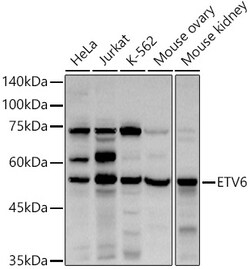
ABclonal Technology ETV6 Rabbit pAb
This gene encodes an ETS family transcription factor. The product of this gene contains two functional domains a N-terminal pointed (PNT) domain that is involved in protein-protein interactions with itself and other proteins, and a C-terminal DNA-binding domain. Gene knockout studies in mice suggest that it is required for hematopoiesis and maintenance of the developing vascular network. This gene is known to be involved in a large number of chromosomal rearrangements associated with leukemia and congenital fibrosarcoma.
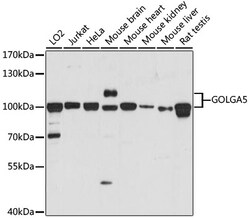
ABclonal Technology GOLGA5 Rabbit pAb
The Golgi apparatus, which participates in glycosylation and transport of proteins and lipids in the secretory pathway, consists of a series of stacked cisternae (flattened membrane sacs). Interactions between the Golgi and microtubules are thought to be important for the reorganization of the Golgi after it fragments during mitosis. This gene encodes one of the golgins, a family of proteins localized to the Golgi. This protein is a coiled-coil membrane protein that has been postulated to play a role in vesicle tethering and docking. Translocations involving this gene and the ret proto-oncogene have been found in tumor tissues, the chimeric sequences have been designated RET-II and PTC5. A pseudogene of this gene is located on the short arm of chromosome 5.
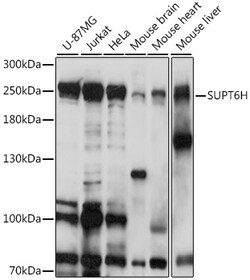
ABclonal Technology SUPT6H Rabbit pAb
Enables histone binding activity. Involved in negative regulation of histone H3-K27 methylation and positive regulation of transcription elongation from RNA polymerase II promoter. Predicted to be located in nucleoplasm. Predicted to be part of transcription elongation factor complex. Predicted to be active in transcriptionally active chromatin.